Category: Dailies
Weekend Review, May 10
Hey everyone,
 First off, I hope everyone was able to pry themselves away from the computer screen and give their mom a hug & kiss and said “I love you” to her on Mothers’ Day yesterday.
Anyway, I think it’s safe to say that this weekend was a fairly active, eventful one. You only had Mark Teixeira turn in his third three-homer game (as well as his 13th with five-plus RBIs), Rod Barajas hit two home runs to give him nine on the year (most among catchers), Jayson Werth took batting practice for three days against the Braves, the real Jake Peavy returned to action, and Dallas Braden (pictured right, hugging his grandmother after the game) tossed the 19th perfect game in Major League history. I’d say that’s enough to keep one person entertained.
While I would love to go on and on about Braden’s achievement, in terms of fantasy baseball, it is such a rare anomaly, that it really isn’t worth talking too much about. But, after reading about the game later on (I was at work during the two-hour sprint of a game), I remembered how Mark Buehrle‘s and David Cone‘s performances took a sharp tumble after each of their perfect games. With that in mind, I’ll do some digging around tonight and will have a post up tomorrow about how perfect game pitchers do following their feat. This will hopefully help Braden starters figure out whether to start him, sit him or trade him to other owners who now overvalue the southpaw.
Now, on to the other goings-on of the weekend:
Teixeira turns third home-run hat-trick
 By now, it’s common knowledge that Teixeira in April is about as effect for your fantasy team as it is using water to put out a grease fire, as his career April stats of .235/.342/.411 show. But I don’t think anyone was expecting for him to surpass his April RBI total within his first seven games in May. Incredibly enough, these kinds of games are not unusual for Tex. Like I said before, this was the third time he’s hit three home runs in a game (June 22, 2008 for ATL against SEA; June 13, 2006 for TEX against BAL).
Not only that, but Saturday’s shellacking of the Sox gave the former Georgia Tech Yellow Jacket his 13th game with five or more RBIs. His career-high is seven, which he did on June 13, 2006 and on Aug. 17, 2004 when he hit for the cycle. During his years with the Rangers, Teixeira accomplished this feat at least three times a year between 2004 and 2006, but only twice between 2007 and last weekend.
But now that he isn’t bouncing from team to team and is smack in the middle of one of the best lineups in the league, it shouldn’t be surprising to see five RBI games becoming more frequent again.
Putting together Peavy
According to published reports this weekend, 2007 NL Cy Young winner Jake Peavy was seen pitching in the South Side of Chicago on Saturday, May 8. This was confirmed to be the real Peavy and not the pitcher who frustrated White Sox fans and Peavy owners through the first month of the 2010 season, as he earned his second win in as many games by holding the Blue Jays to two runs on three hits with eight strikeouts in eight innings.
So, remember how last week I was writing that Peavy was in a tailspin he wouldn’t get out of for a while? You do? Well, this is what’s going on right now as I write this blog:
 After two straight dominant starts, it’s safe to say that Peavy is most likely back to his usual self. So what’s the difference between April and May? For one thing, it’s his velocity. The average speed on Peavy’s fastball this year is 91 mph, but on Saturday, he averaged 92.1 mph on his four-seam fastball and 92.5 on his two-seamer. As far as his put-away pitch, the slider, his average speed was 83.3 mph. On Saturday, that dropped down to 82.5 mph on average.
While one may think that would be bad, the speed differential is helpful in this case because, if thrown with the same arm speed as the fastball, a batter who commits to swinging will be out in front of the pitch (basically, a similar concept to the changeup, only with dramatic movement down and to the pitcher’s glove side). The only caveat is that if there is too big of a differential, the batter will have enough time to react and readjust.
One last thing that I noticed about Peavy while combing through Fangraphs.com: the release point of his pitches. Now Peavy is at his best when his arm slot is at a low three-quarters angle, but if it gets too low, his pitches flatten out, lose velocity and/or movement and become more hittable. When you look at this graphic on the top right-hand corner, notice the general height of the release points from the horizontal axis from his two May outings, then look at the RPs from April. The RPs in April are lower when he did poorly and higher when he did well.
Getting your money’s Werth
 Question: what happens when you combine Chuck Norris, the Geico Caveman and a power-hitting right fielder?
The man at the right, Jayson Werth.
There seems to be little Werth can’t do (besides finding a decent barber). After hitting 16 doubles in 2008 and 26 in 2009, he has a Major League-leading 16 doubles through 31 games this season. In just the past week, where he was named National League Player of the Week, he collected four homers and four doubles while slugging an even 1.000. He’s also amassed back-to-back 20 steal seasons in 2008 and 2009, and has thrived in the postseason (.285/.393/.650).
Now though everyone is riding free and easy as Werth hammers away, all of you who have him on your roster must realize there will be some New York City-sized potholes in the near future. Why? Well for one thing, it is highly improbable for anyone to maintain a .408 BABIP (batting average, balls in play) like Werth. Since the stat was regularly recorded in 2002, only one player has ever crossed the .400 threshold, with said player being Jose Hernandez in ’02, so if players like Ichiro Suzuki, Derek Jeter and Albert Pujols have not done it, the likelihood of Werth accomplishing that feat is not very good.
Plus, there are also other, more obvious reference points to expect him to slow down: he’s never hit above .300 in any Major League season; he averages 152 strikeouts per 162 games; he has yet to drive in 100 or more runs in a single season; and finally, he’s on the wrong side of 30 years old.
Don’t get me wrong. I’d love to have him on my team right now (I’m looking right at you, Adam Lind). All I am saying is to not anchor your offense around Werth.
Laughing Matters
Just before I go, here’s a little forray into my main league, where my squad is called The Men Who Laugh. It’s a 12-team, head-to-head mixed league based on a points system that favors hitters with guys I went to HS with. It’s usually a lot of fun, especially when members make long, rambling posts late at night, and the draft usually features a few moments that bring everyone to tears from laughter (i.e. – I hosted the draft our first year, and one of the guys, needing to make a call and his cell was dead, asked me in all seriousness if the phone on the wall was real. You cannot make stuff like that up).
To avoid coming off like an arrogant jerk or whiner, I’m not going to talk much about the moves I make, unless it is key to a point I’m making in the body of a post. The point of any story about my league isn’t to babble on, but to either illustrate a point or just tell a funny story.
Anyway, one owner, “Tyler,” made a very peculiar deal this weekend, sending over Chase Utley (his first pick), Justin Verlander and Buster Posey (not a keeper league, but we have two spots for Minor Leaguers) to “Rick” for Alex Rodriguez (his first pick), Ben Zobrist and Tim Hudson. While I initially thought “Rick” got the better end of the deal, I looked at the roster situations and determined that both sides won out.
“Rick’s” starting pitching was shaky with Hudson, Francisco Liriano, Matt Cain, Ricky Nolasco, Clay Buchholz, Max Scherzer and J.A. Happ, while both A-Rod and Zobrist have had mediocre starts. After this deal, he was able to switch Pablo Sandoval to 3B and choose between Adam Dunn and Billy Butler to start 1B while gaining an ace in Verlander. On the other side of the coin, “Tyler’s” starting 2B and 3B go from Utley and Chone Figgins to Zobrist and A-Rod. Though he’s losing one of the two best 2B around, he will probably get more production from the incoming players than the outgoing pair. As for losing Verlander, well, you can do that when you also have Tim Lincecum, Phil Hughes and Jeff Niemann on your staff.
The point of this is to not focus on the addition or subtraction of one particular player, but to look at the net gain or loss, especially if you’re in a points-based league.
– Michael Echan
A Tiger Finally Earns His Stripes
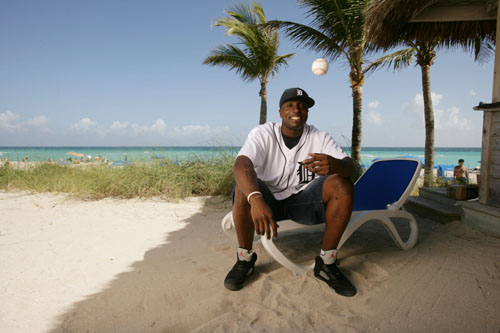
It’s all in the smile.
You can tell when Dontrelle Willis is right when he’s showcasing the smile and enthusiasm that endeared him to baseball fans years ago, because that’s usually when he’s dominating batters in a way that endeared him to fantasy owners years ago, too. And for the first time in three years riddled with injuries, demotions and mental anguish, that positive aura has made repeated returns.
While his first four outings were nothing to be proud of, the switch clicked “on” in Willis’ head on April 29 against Minnesota as he fired six shutout innings, allowing four hits and two walks with six strikeouts. The Oakland, Calif. native threw 57 of his 101 pitches for strikes and bounded off the mound, yelling and pumping his fist after getting the last out in the sixth. It was his best game as a Tiger since May 19, 2009, when he fired 6 1/3 shutout frames against Texas, holding the Rangers to a hit and two walks with five whiffs. Back to 2010, he faced those same Twins on May 4 and despite allowing three runs on four hits and three walks, he also fanned six in 5 1/3 frames and threw 57 of 97 pitches for strikes.
 The common denominator here is consistency. Ever since he pitched in the inagural World Baseball Classic back in 2006, consistency has been nothing short of elusive for Willis. After posting a 2.1 BB/9 rate in 2005, his best season ever, these are his walk rates from 2006 to 2009: 3.3, 3.8, 13.1, 7.5. Maybe having to pitch with mid-season intensity in March ’06 threw a major monkey wrench into his mechanics, or maybe it was something else, but he clearly was out-of-sync for the longest time. He grew frustrated and began to fight himself, forcing things to happen that used to come naturally. The injuries then began to come into the picture, shortly accompained by the crippling presence of depression and anxiety (more on this later).
To the credit of Detroit manager Jim Leyland and general manager Dave Dombrowski, they stood by Willis’ side and did all they could to support him until he regained his footing. And after long last, Willis has rewarded their patience. Three of Willis’ five starts have resulted in quality starts (six or more innings, three or fewer earned runs allowed), this after having just two quality starts in his last two seasons combined.
According to FanGraphs.com, Willis has ironed out his mechanics so that the relase point for all his pitches has become highly consistent, allowing for greater deception against hitters. His velocity seems to have improved, as well. During his April 29 start against Minnesota, Willis hit 94 mph late in the sixth inning, though he has shown he isn’t trying to fire it in all the time, as his average fastball velocity is down half a mile from 89.9 in 2009 to 89.4 this season. His other pitches have increased in velocity as well, especially his cutter (80.3 to 84.5), slider (81.7 to 82.0), curve (77.3 to 78.1) and his newest weapon, the two-seam fastball (83.8 to 87.7).
These jumps in velocity mean batters have a little less time to decide the type and possible trajectory of each pitch, forcing them to commit sooner than they like and resulting in weak contact or a complete swing-and-a-miss. Combine this with the increased deception of a consistent release point and you will get the prime recipe for keeping batters off-balance.
As far as the fantasy implications go for Willis’ return to form, it can only mean good things. With Willis’ complicated delivery, walks should always remain a concern, but back in 2005, his BB/9 rate was 2.1, so it is possible for him to keep a handle on those. He’s demonstrated the ability to hit the mid-90s with his heater and Comerica Park has always been pitcher-friendly, so it’s safe to say that Willis is once again a useful mixed leagues option.
– ME
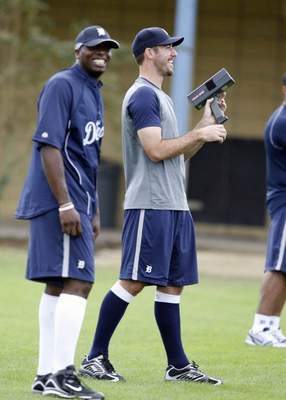
All is not what is seems…
With the first month of the season out of the way, fantasy owners are getting a better feel as to how their players are shaping up. Some of them are doing about as well as expected (Albert Pujols, Tim Lincecum) and some are doing wildly better than could be expected (Robinson Cano, Colby Lewis), but the group of players who are on our minds the most are the ones who are giving owners another ulcer with every weakly-hit ground ball to second or pitch juuust a bit outside (a tip of the hat and best wishes to Bob Uecker) when they should be dominating.
Now, it’s a common reaction for owners to bench these players or, if they’re doing so poorly, to cut them altogether. But often times, owners aren’t looking carefully enough at the player’s performances. Many statistics commonly used in the fantasy world have long since been exposed as severely flawed (RE: batting average, RBI, wins), and some of the new metrics show that slumping players are pretty much thisclose from posting their usual stats.
There are plenty of examples to be had every year, but to avoid frying anyone’s brains with information overload, I’m going to stick with two hitters and two pitchers. Each is going in the opposite direction of their counterpart, and the purpose of this is identify particular trends and/or stats that can help an owner decide whether to keep a player, cut him, or trade him to an unwitting opponent.
Looking up
Garrett Jones, OF/1B PIT
 Raise your hand if you saw Jones’ 2009 season coming? No one? I thought so. The then-28-year-old rookie helped push many fantasy teams to either a championship or at least a playoff spot thanks to a year where he mashed 43 extra-base hits in only 82 games, and it appeared he’d be able to continue such a performance thanks to a patient, intelligent approach at the plate. Then 2010 and a .221/.358/.407 stat line came.
Odds are, a lot of Jones owners did one or more of the following: bench him, put him on the block, or cut him altogether. I almost did the latter of the three, but I felt that I wasn’t seeing the whole picture…and I wasn’t. When most players are taking a full-fledged nose-dive, they’re often expanding their strike zone: swinging (and missing) at more pitches out of the zone while making less contact. So far, Jones has done the opposite of that. The Braves 14th-round pick in 1999 swung at 21.7 percent of pitches outside of the zone in 2010, as opposed to 29.3 percent last year. And when he does swing, he’s slightly better this year at making contact, putting the bat on ball 78.1 percent of the time versus 77.5 percent last year.
So what does this mean? Basically, Jones is due for a good run. It’s all a matter of “hitting them where they ain’t.” If you still have Big Garrett on your roster, make sure he stays there.
Cole Hamels, SP PHI
Images from Hamels’ horrid April 23 game against Arizona still give me nervous twitches, and anyone who sees his HR/9 ratio of 2.1 will probably do the same. A 5.28 ERA and 1.47 WHIP won’t help matters, either. But, once again, here is another example of the numbers not telling the entire story.
First off, his HR/9 rate is grossly inflated by that one game where he allowed four home runs. That’s about as fluky as it gets. Secondly, his BABIP sits at an unusually high .357, as opposed to his career mark of .298, so you know those hits will soon turn to outs. And when batters are getting the bat on the ball, they’re doing so with less authority. Last year, his line drive and fly ball rates were 20.8 and 38.7 percent, respectively, but now they’ve dipped to 14.8 and 38.6 percent while his ground ball rate has spiked from 40.4 percent to 46.6. Translation for the mathematically-impaired: batters don’t hit the ball too good anymore off Cole this year.
Lastly, keep in mind Hamels’ history: April and May have been his worst two months. During those two months, his ERA is 4.19. In the last four months, that figure drops to 3.51.
Falling down
Jake Peavy, SP CHW
 For once, you cannot pin Peavy’s troubles on an injury or the World Baseball Classic (don’t get me started on that. I devoted a report to that such thing, but I digress…). His fastball is still consistently in the mid-90s and all of his pitches still have late, biting movement. It was expected to see a bump in some of his numbers given the change from pitching against NL lineups in cavernous PETCO Park to facing AL lineups in the launching pad that is U.S. Cellular Field. But this much of a bump?
A 6.31 ERA, 1.60 WHIP, 9.1 H/9, 5.3 BB/9 and a 7.8 K/9? And this is including his May 3 outing against Kansas City. Ouch.
So what gives? Right now, Peavy is going through the exact opposite of what Hamels is experiencing now. For his career, Peavy has a GB-pct of 41.5 while his LD-pct and FB-pct scores check in at 19.7 and 38.7, respectively. This year, though, that first figure has dropped to 31.5 while the other two have risen to 26.1 and 42.4, respectively. Add in the fact hitters are making contact on 83.9 percent of their swings against him (career: 75.5), and you’ve got the recipe for a very frustrated pitcher…and fantasy owner.
Now, this is Jake Peavy I’m talking about, so I would never think about suggesting cutting him. But odds are that your league has at least one person who is attracted to big names like goats are to shiny objects. Your job is to find that person and convince him to hand over a good and a really good player for Peavy, promising that you know he’ll turn it around soon…even though his body of work suggests otherwise.
Adam Lind, OF/DH TOR
“Gone with the Lind” would be a perfect title explaining the absense of Adam’s power. A year ago, he was hitting .315/.400/.533 with 12 extra-base hits and 20 RBIs. Now, it’s just 10 XBH, 14 RBIs, his OBP is down 70 points and his slugging has slid 93 points.
After a little digging, I’ve come up with two key factors in his decline. The first being everyone who is batting in front of him. Toronto posted a .333 OBP last year, seventh-best in the AL, but now the Blue Jays are dead last with a .303 OBP. It’s a lot easier for pitchers to do their job when they don’t have to worry about bothersome baserunners. In turn, they’re able to make Lind expand his strike zone, as evidenced by his strikeout rate soaring from 18.7 percent to 29 percent. This is happening because Lind is swinging at more pitches outside the zone (24.9 to 26.3) and fewer pitches inside the zone (64.8 to 61.8). Any hitting coach worth his calloused hands would tell you that’s a recipe for failure.
Again, what is one to do? For once, it’s difficult to tell. Lind doesn’t have too much of a track record to make any sound predictions, so it’s more of a crap shoot than it usually is. Right now, just do some simple matchup observations. If Lind does well against most of the pitchers in the upcoming week, start him; if not, sit him.
And, if you’re like me, find a nice, secluded spot somewhere that you can bang your head into the wall knowing you could have picked Andre Ethier instead.
– ME
 The Fact of the Matter